Use Case Overview
As part of a project within the National Recovery and Resilience Plan (PNRR), there is a need for a use case to train a model that, based on the movements of a cow (monitored through an IoT collar), validates whether the growth occurs outdoors or indoors in a stable.
In addition to creating the ML model and managing its entire lifecycle, Data Analytics System will also validate satellite data on a blockchain and provide analytical results to a traceability system that will expose the outcome during the scanning phase of the QR code displayed on the finished product.
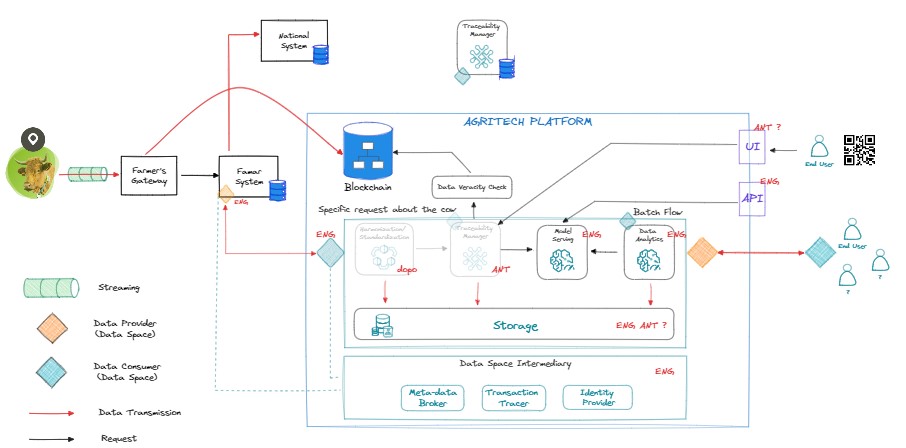
Figure 2.9.3: Agritech Contribution 01
Zooming into Project
In the context of an Agritech project, Data Analytics System can offer tools and methods to efficiently manage and analyze large amounts of agricultural data. Here's how you could use Data Analytics System in an Agritech project (Figure 2.9.3: Agritech Contribution 01):
1.Data Collection and Preprocessing
Data Analytics System can assist in collecting data from various sources such as IoT sensors, satellite images, and existing databases. Additionally, it provides tools for data preprocessing:
- Data Cleaning: Removing missing or anomalous data.
- Data Normalization: Adjusting data to ensure uniformity.
- Data Integration: Combining data from different sources.
2.Data Analisys
Data Analytics System offers numerous algorithms for analyzing agricultural data:
- Statistical Analysis: To understand trends in crop yield data, climate data, etc.
- Predictive Analysis: Using machine learning models to predict crop yields, plant diseases, and other relevant metrics.
- Spatial Analysis: For analyzing geographic data, such as land maps and crop distribution.
3.Data Visualization
Effectively visualizing data is crucial for making informed decisions. Data Analytics System provides tools to create:
-
Interactive Charts: To dynamically explore data.
-
Thematic Maps: To visualize crop distribution, soil moisture, and other geospatial variables.
-
Customized Dashboards: To monitor key metrics in real-time.
4.Process Automation
In the context of Agritech, automation can increase efficiency:
- Automated Data Collection: Using sensors and drones to collect data automatically.
- Automated Analysis: Configuring analysis pipelines that automatically perform predictive analyses on new data.
- Automated Decision-Making: Implementing decision support systems that use analysis results to suggest actions.
5.Specific Applications
- Crop Monitoring: Using sensor data and satellite images to monitor crop health and identify issues early.
- Irrigation Management: Analyzing soil moisture data and weather forecasts to optimize water use.
- Crop Planning: Using predictive models to plan crop rotation and maximize yields.
- Pest Management: Analyzing data to predict and prevent pest infestations.
Data Analytics System in the Project
Example of Using Data Analytics System in an Agritech Project
Imagine an Agritech project aiming to optimize corn production. Here's how you could use Data Analytics System:
1.Data Collection:
Collect data from soil moisture sensors, weather stations, and satellite images.
2.Preprocessing:
Clean and normalize the data to ensure quality.
3.Predictive Analysis:
Use machine learning algorithms to predict corn yields based on future weather conditions.
4.Visualization:
Create maps and charts showing yield predictions and water stress areas.
5.Automation:
Implement a system that sends notifications to farmers when it's time to irrigate or fertilize based on predictions and real-time data.
In conclusion, Data Analytics System can be a powerful tool in an Agritech project, offering advanced functionalities for data collection, analysis, visualization, and automation to improve agricultural efficiency and productivity.