Introduction
In recent years, artificial intelligence and machine learning techniques have demonstrated strong potential in responding to many of the typical challenges of the agrifood domain, such as improving product quality, optimizing processes, supporting traceability and assessing sustainability. However, the effective adoption of these technologies often encounters organizational and technological difficulties. The absence of shared tools, the fragmentation of solutions and the poor integration between different skills make the transition from experimentation to real operation complex. In this scenario, data science and machine learning platforms take on a central role as enablers.
The Agritech project, and in particular the SPOKE 9, have a clear objective: to use inference and automatic reasoning models to transform heterogeneous data from the agri-food supply chain into interoperable, reliable and usable traceability. To this end, solutions have been developed that have led to the creation of an integrated digital ecosystem to support agri-food supply chains: the METRIQA platform to ensure continuity between experimentation, production and validation of results.
METRIQA is the technological center of gravity where infrastructural building blocks (object and flow storage, identity, image/container repository and operational monitoring) are combined with an advanced application layer, where ALIDA (Engineering's product) offers an asset catalog with lineage, workflow designer, MLOps tools for the model lifecycle and model serving scalable tools.
In addition, it is possible to integrate Data Space (IDS/True Connector) connectors, thanks to which datasets and models can be published and shared in a governed way, with explicit and revocable usage policies. The result is a platform that combines governance, technical traceability and interoperability between partners and use cases.
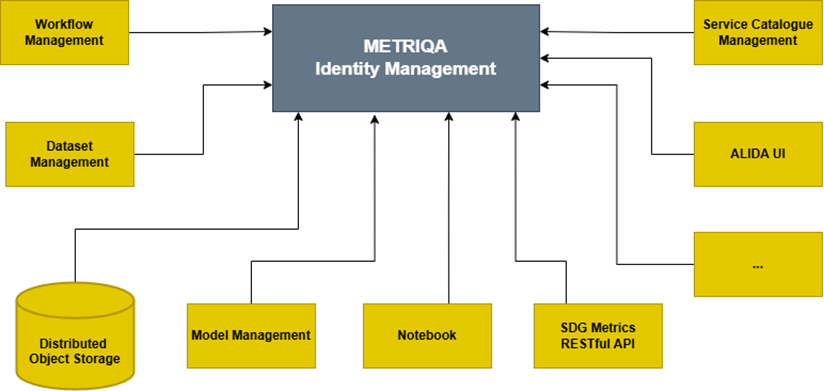
The figure above shows the integration scheme of the METRIQA identity management system with some platform modules, including ALIDA, the Notebook environment, distributed storage, REST services for SDG metrics, and components for managing workflows, datasets, and models.