SDG Metrics Digitalization
The information from the SDG Technical-Operational Manual has been transformed into digital resources so that it can be used not only for reporting, but also to:
- connect KPIs to traceability data,
- integrate sustainability into company workflows,
- enable alerts, automatic checks, and dashboards.
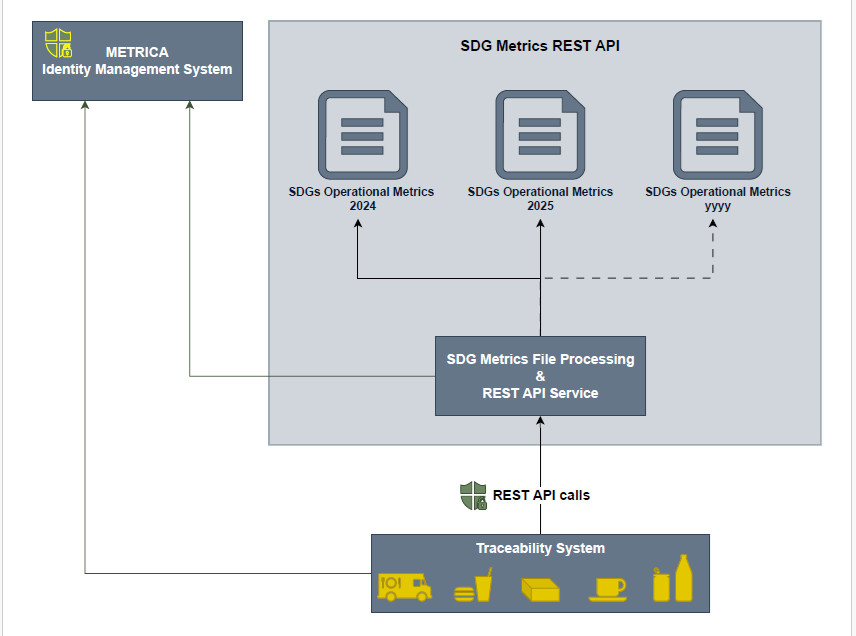
To enable this transition, the Technical-Operational Manual has been supported by a dedicated software component designed to expose the metrics through REST API interfaces, as illustrated in the following figure:
SDG metrics are maintained via versioned Excel files, chosen as a configuration layer for several reasons:
- They allow for updating and maintenance by non-technical domain operators;
- They allow for the management of multiple versions over time;
- They make metric evolution a controlled, governed, and verifiable process.
The software component allows the API call to explicitly specify the desired version of the metrics, enabling consistent and traceable use of the information.
REST API Features
The service exposes APIs that allow:
- Search for metrics by individual SDG;
- Query by keyword;
- Selection of the version to use.
In this way, indicators can be dynamically retrieved from application systems (e.g., traceability), without depending on static documents or editorial representations.
Security and Federated Access
From a security perspective:
- Service access is protected via OAuth2,
- Identity management is federated via Keycloak,
- Authentication for machine-to-machine interactions is also supported.
This ensures consistency and security in collaborative and multi-organization scenarios, while preserving data governance.
Operational Integration in the Digital Technical-Operational Manual
The operational validation involved integrating the digital Technical-Operational Manual into the Movilitas.Cloud traceability platform, a proprietary solution from Engineering Ingegneria Informatica.
The objective was to verify:
- the effective integration of the digitalized manual into a real system;
- its effectiveness as an operational tool to support SDG metrics communication and management processes.
The platform is designed to:
- manage product history;
- track production and logistics processes;
- acquire data from sensors;
- publish information to users and external systems.
These characteristics make it an ideal environment for testing the transition from a static manual to an active digital component, integrable into application workflows.
Architecture of the Digital Technical-Operational Manual
The following figure represents the general scheme of the manual integration into the Movilitas.Cloud ecosystem.
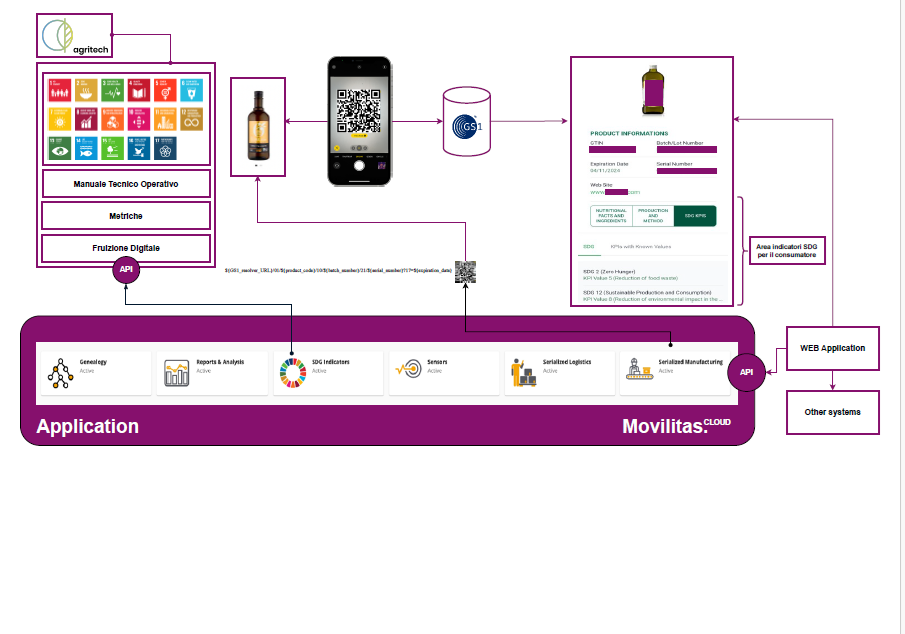
The digital manual is implemented as a REST service dedicated to managing and displaying SDG metrics, with the following functions:
- Management of metrics as structured and versioned documents;
- Querying via API for SDGs or keywords;
- Selection of the temporal version of the metrics.
The metrics are divided into separate documents, for example:
- SDG Operational Metrics 2024
- SDG Operational Metrics 2025
This allows you to:
- Manage the evolution of indicators over time;
- Maintain semantic continuity;
- Update content without impacting consumer systems.
Integration into the traceability workflow
The validation scenario, relating to the extra virgin olive oil domain, uses a simple application flow:
-
The consumer scans a QR code on the packaging.
-
The QR code contains standard identifiers (GTIN, lot, serial number).
- A GS1 resolver service interprets the identifier.
- Movilitas.Cloud retrieves:
- traceability data;
- SDG metrics via the digital handbook REST service.
- The information is aggregated and displayed to the end user via a web interface.
This demonstrates that:
- the metrics can be dynamically retrieved;
- they come directly from the digital manual, not from PDF documents;
- they can be integrated into actual traceability workflows.
Displaying SDG metrics to the end user
The following figure shows the web interface obtained after scanning the QR code.
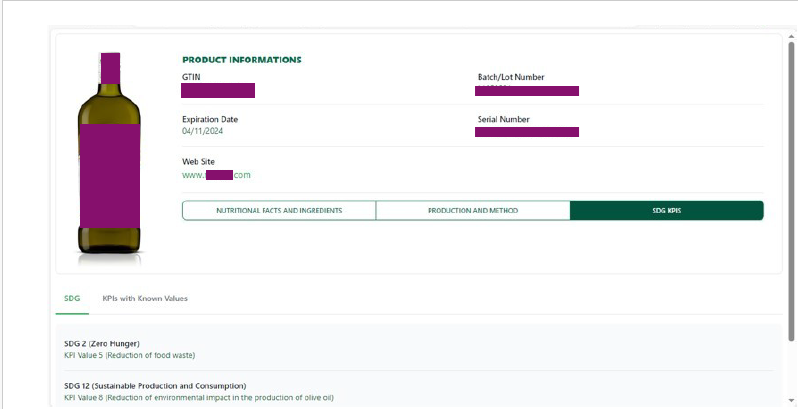
The content is organized into three sections:
- General Product Information
- Production Process and Logistics
- Sustainability and SDGs
The SDG section uses:
- the relevant indicators,
- the contextual descriptions,
- the associated KPIs
from the digital Technical-Operational Manual.
This makes it possible to present complex sustainability content to consumers in a simple way, while maintaining a link to a structured, coherent, and verifiable information base.
The validation confirmed that the digital Technical-Operational Manual:
- Effectively integrates into real traceability systems;
-
- Overcomes the separation between static documents and operational processes;
-
- Makes SDG metrics an active element of the supply chain information flow;
-
- Enables reuse, interoperability, and transparency towards the consumer;
-
- Supports the future evolution of indicators in a controlled manner.