Pascol Use Case
The Pascol use case focuses on the digitalization of the beef supply chain originating from extensive farming operations, where animals live and move across very large and often remote natural areas. Pascol operates as a coordinator of the value chain and aims to supply high‑quality beef to large‑scale retail, relying on a network of specialized partners for slaughtering, cutting, and logistics.
This use case demonstrates how the extensive cattle farming supply chain can be transformed through Data Spaces, Data Analytics Systems, Machine Learning, and Model Serving. The integration of these elements enables the collection of heterogeneous data, advanced analysis, and governed data sharing, creating a predictive, secure, and fully interoperable end‑to‑end traceability system.
Below are the capabilities in detail:
Data Space
The Data Space allows all stakeholders in the supply chain to share data in a secure and controlled manner. In the Pascol case, the DataSpace guarantees: - Data governance, with ownership maintained by the data owner. - Access control, through roles, permissions, and security policies. - Data federation between different stakeholders, such as breeders, slaughterhouses, and processors. - Interoperability with IoT, ERP, and blockchain systems. - Regulated sharing of sensitive data (animal health, environmental parameters, movements).
Data Space is the foundation that enables digital collaboration between parties that traditionally operate on independent systems.
Data Analytics System
The Data Analytics System enables the continuous management and processing of collected data. Specifically, it allows: - integrating data from sensors, RFID, mobile apps, and corporate databases; - orchestrating complex workflows based on microservices; - analyzing streaming and batch data; - extracting key indicators related to animal welfare, productivity, and risks; - automating pipelines that feed machine learning models.
The system thus creates a continuous chain: data → analysis → insights → operational actions.
Machine Learning
Thanks to the collected and prepared data, the Data Analytics system supports the creation of Machine Learning models Asset > Workflow capable of: - predicting pathogen attacks; - identifying thermal and behavioral stress conditions; - identifying nutritional deficiencies; - anticipating production problems; - detecting anomalies using neural networks and statistical algorithms.
The entire model lifecycle is managed through MLOps capabilities, which allow for versioning of different iterations, performance comparisons, quality validation, and controlled updates. This ensures a rigorous and transparent approach to model development and maintenance, ensuring their reliability over time.
Model Serving: Ready-to-use models in the supply chain
Model Serving Development > Serving makes ML models immediately available in the Pascol supply chain: - Operators receive real-time alerts on animal health; - Models are exposed via APIs that can be integrated into apps, dashboards, and management systems; - Predictive results are accessible in the Data Space, with full access control; - Farmers can make decisions based on up-to-date and reliable data.
This capability makes machine learning an integral part of daily operations.
IoT Infrastructure and Field Technologies
Data collection is made possible through: - RFID for animal and batch identification; - physical sensors (temperature, humidity, irradiance, acceleration, GPS); - biosensors for health parameters and VOCs; - LoRa and satellite LoRa communications for remote areas; - edge computing in collars to generate immediate alerts.
Traceability through Blockchain and Data Space
Traceability is ensured by a hybrid approach between blockchain and data space: - Federated private blockchain to ensure data immutability and security; - Smart contracts to automate processes and verification; - Data space integration to federate data from IoT, ML, and ERP.
The following figure shows the set of IoT components used for this use case:
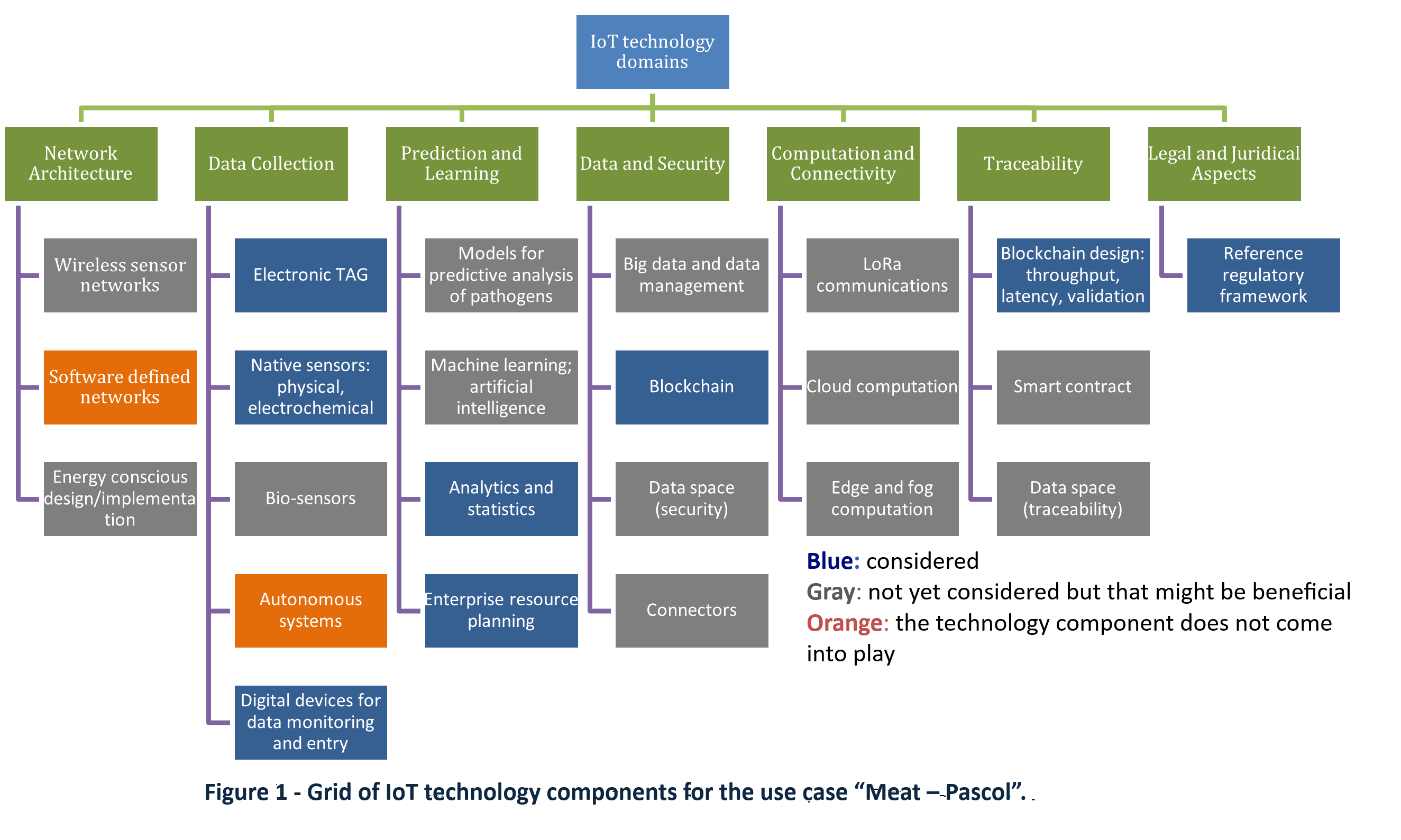
In summary, Pascol represents an innovative model of digitalized extensive livestock farming, capable of: - improving transparency; - supporting predictive decisions; - enabling interoperability between supply chain stakeholders; - optimizing productivity and animal welfare.
The combined use of IoT, data space, data analytics, ML, and model serving creates a resilient and future-oriented ecosystem.